Tafsir al-Tabari preserves the debate between the salaf over whether the
spring where the sun sets is muddy or warm. Tabari says both readings are correct because
the sun could set
in a spring that is both hot and muddy.
Tafsir al-Tabari — Quran 18:86 (10/374-378)
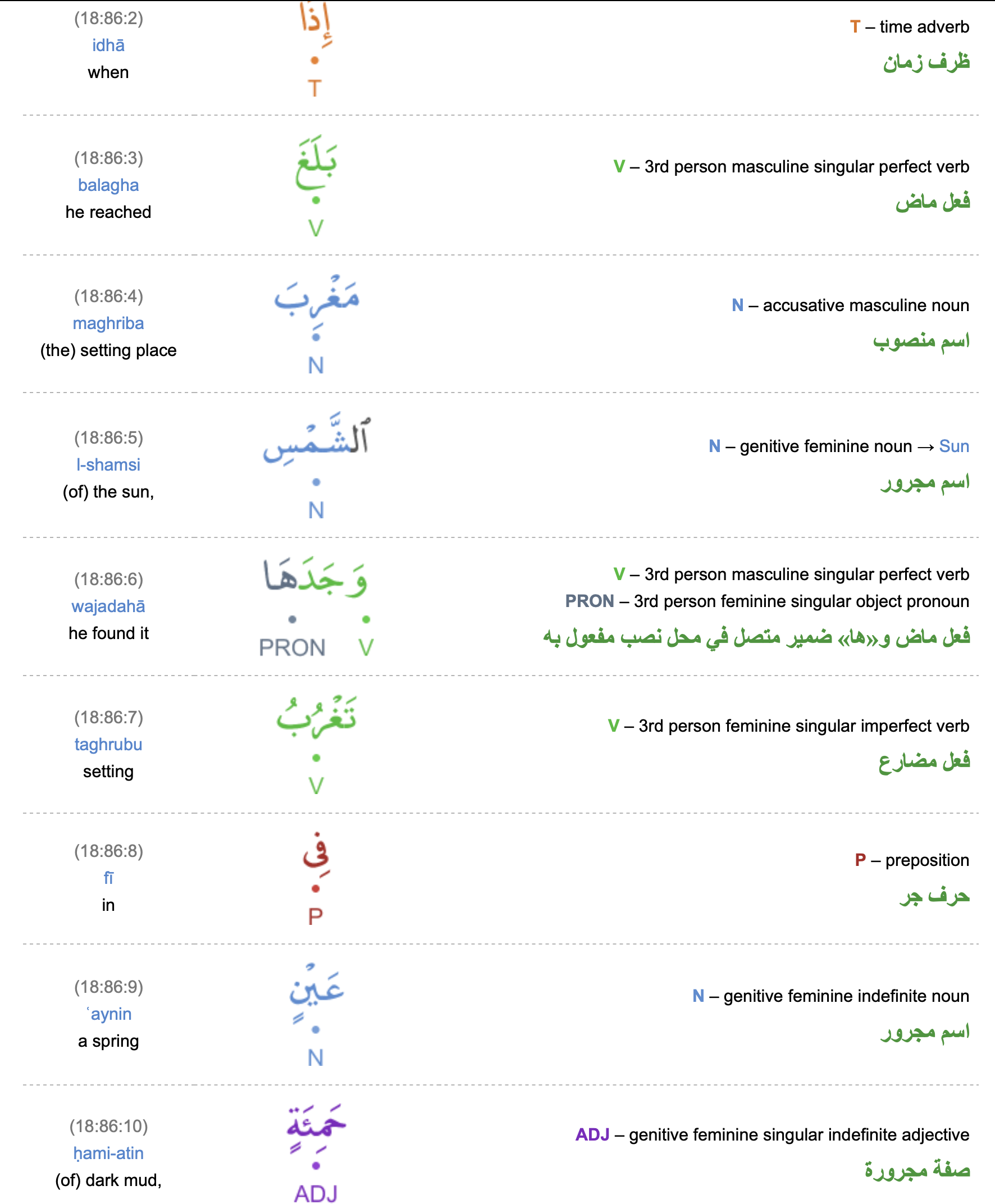
(the setting-place of the sun, he found it setting in a muddy spring). The readers differed on how
to read this. Some of the readers of Madina and Basra read it as (in a muddy spring), meaning
that the sun sets in a spring that contains mud. While a group of the readers of Medina
and the majority of the people of Kufa read it as, (in a warm spring) meaning that the sun
sets in a spring of warm water. The people of commentary have differed on the meaning of
this depending on the way they read the verse.
Mention of those who said: (setting in a muddy spring)
Muhammad b. Al-Muthanna ← Ibn Abi Uday ← Dawud ← Ikrimah ← Ibn Abbas:
(and he found it setting in a muddy spring) he said: In black mud.
Ibn al-Muthanna ← Abd al-Ala ← Dawud ← Ikrimah on the authority of Ibn Abbas,
that he recited: (in a muddy spring) he said: it is black mud.
Al-Husayn b. Al-Junayd ← Sayd b. Salamah ← Ismail b. Aliyah ← Uthman b. Hadir: I
heard Abdullah b. Abbas said: Muawiyah recited this verse, and he said (warm spring)
and Ibn Abbas said: it is (muddy spring). He said: So they sent to Ka'b Al-Ahbar and
asked him. Ka'b said: As for the sun, it disappears in 'Thatin', which matched what
Ibn Abbas said, and the word tha'at means "mud".
Yunus ← Ibn Wahb ← Nafi' b. Abu Na'im ← Abd Al-Rahim Al'Araj: Ibn Abbas used
to speak about the muddy spring and would pronounce the word as (in a muddy spring) then he
explained it as black mud. Nafi' said that Ka'b was asked about it and he said:
"You are more knowledgeable in the Quran than I am, but I find it in the Book disappearing in
black mud."
Muhammad b. Saad ← his father ← His uncle ← his father ← his father ←
Ibn Abbas: (and he found it setting in a muddy spring) he said: it is black
mud.
Muhammad b. Amr ← Abu Asim ← Issa ← Ibn Abi Najih ← Mujahid: (in a muddy
spring). He said: black mud.
Al-Qasim ← Al-Husayn ← Hajjaj ← Ibn Jurayj ← Mujahid: (it setting in a
muddy spring). he said: mud.
He said: And Amr b. Dinar ← Ata b. Abi Rabah ← Ibn Abbas: I read (in a muddy
spring) And Amr bin Al-Aas recited (in a warm spring), so we were sent to Ka'b. He
said: It sets into black mud.
Bishr ← Yazid ← Sayd ← Qatadah: (setting in a muddy spring) and the
mud: the black mud.
Muhammad b. 'Abd al-A'laa ← Marwan b. Mu'awiya ← Warqa ← Sayd b. Jubayr:
Ibn 'Abbas used to read this letter (In a muddy spring) and he said: Black mud that the
sun sets in.
Others said: Rather, it disappears in a hot spring. Mention of those who
said that:
Ali ← Abdullah ← Muawiyah ← Ali ← Ibn Abbas (he found it setting in a
warm spring) and he said: In a hot spring.
Yaqub ← Ibn Aliyah ← Abu Raja ← al-Hasan: (In a warm spring) he said:
it is hot.
Al-Hasan ← Abd al-Razzaq ← Mamar: al-Hasan regarding (In a hot spring) he
said: It is hot. al-Hasan also read it this way.
And in my (Tabari's) mind the correct opinion is to say that they are
both popular readings
in the land, and each one has a correctness about it and an understandable meaning, and
neither contradicts the other, for it is possible that the sun sets in a hot spring that has
mud and sludge, so a reader who uses "hot spring" is describing its temperature, and the
reader who uses "muddy spring" is describing that it has mud and sludge. Both versions have been
narrated to us.
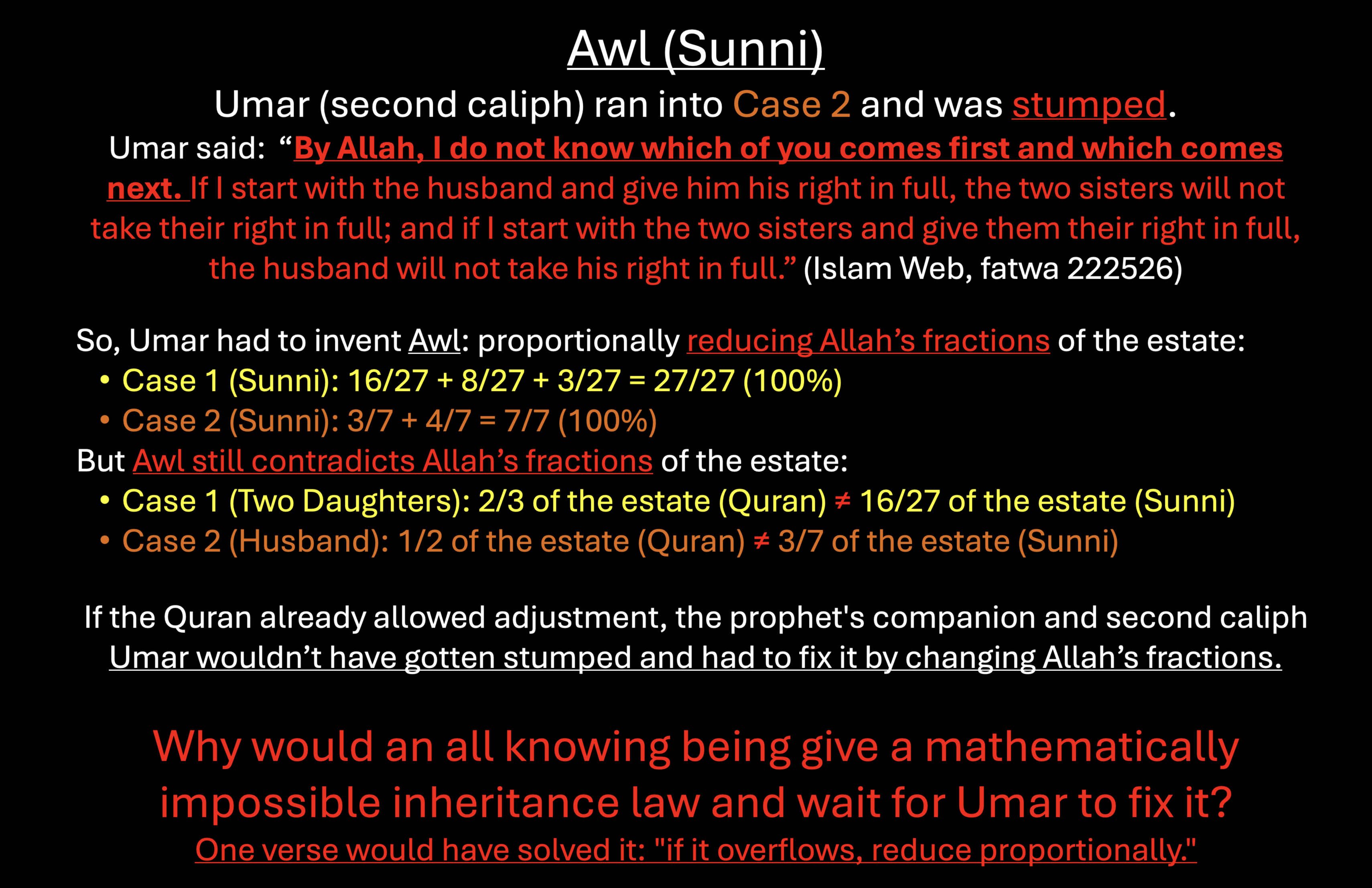
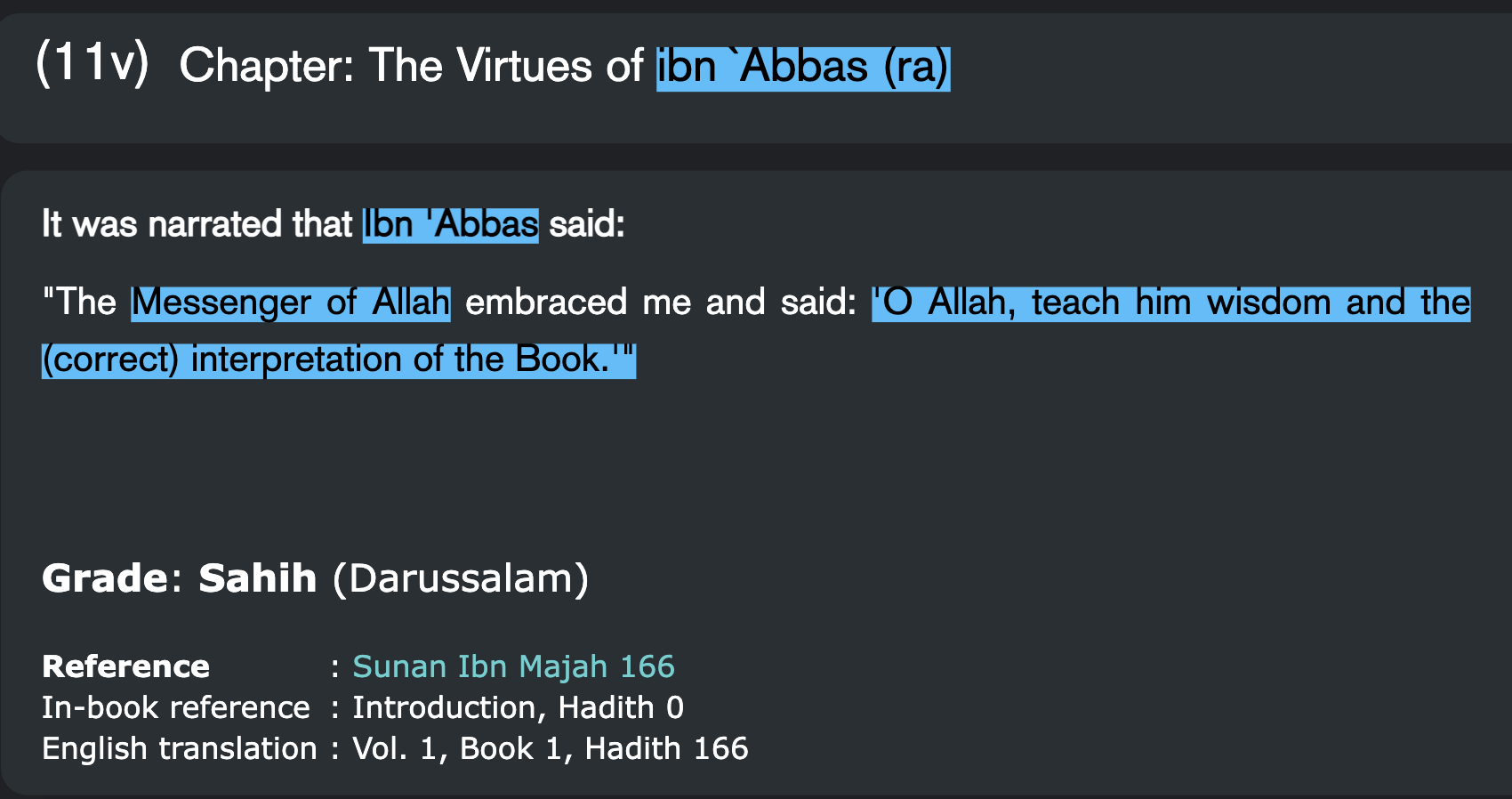
![Slide titled 'Disagreement on How to Fix Allah's Fractions'. Top half: 'Muhammad's Companion Ibn Abbas' - narrated that Muhammad embraced Ibn Abbas and said 'O Allah, teach him wisdom and the (correct) interpretation of the Book.' Sunan Ibn Majah 166, graded Sahih (Darussalam). Right side: Ibn Abbas said 'I was intimidated by [Umar], by God,' and Az-Zuhri said 'By God, were it not for the fact that he was preceded by a righteous imam [Umar], whose conduct was based on piety, no two scholars would have disagreed with Ibn Abbas.' (Al-Bayhaqi, al-Sunan al-Kubra, narration 12133.) Bottom half: 'Companion and 4th Caliph Ali (Shia)'. Ali suggested reducing Allah's fractions for the sisters/wife: Case 1 (Shia) 13/24 + 8/24 + 3/24 = 24/24, Case 2 (Shia) 3/6 + 3/6 = 6/6. But this also still contradicts Allah's fractions: Case 1 (Two Daughters) 2/3 of the estate (Quran) ≠ 13/24 of the estate (Shia); Case 2 (Two Sisters) 2/3 of the estate (Quran) ≠ 1/2 of the estate (Shia).](assets/image-04-cbb35a0e7a1c.png)